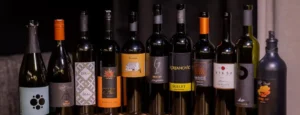
I don’t really drink red wine because I don’t eat fish, an acquaintance told me after I offered him a glass of good red. OK. His reasoning wasn’t quite clear to me. I eat fish and I love red wines, though rarely together. Over the following days I ran a little survey among other people outside the wine world, and nearly two-thirds of them as a rule associate red wine with fish, and white with everything else. A pity. Here are four sea fish paired with three white wines and one red, from an article I wrote two years ago for the portal modnialmanah.com.

Pairing food and wine has its rules, plenty of them, but in the end someone’s own palate is the only judge that decides what suits what. So, a bite and a sip, and let’s see “who beats whom”. I’m certain 99 percent of people won’t notice what was on the fork if they wash down a lightly fried fillet of sea bass with a robust Plavac, nor how the sip of a light Kujundzusa tasted after a bite of grilled amberjack. So here is a little guide to choosing wine for four fine dishes made from well-known sea fish.
The most common marenda
Fried srdele (pilchards) with cold potato salad make a wonderful marenda (a hearty mid-morning meal), especially when the little fish are bought fresh off a boat that has just sailed into port. A young Malvazija, that is, from last year’s vintage, will suit them nicely. A good choice is the base Malvazija from the Fakin winery in Motovun. Fine and gentle on the nose, at first lightly creamy on the palate and then pleasantly saline, with such traits it neatly marries the richness and sweetness of the small blue fish with the freshness of the salad.
The most tender flesh
Hake is a fish of fairly neutral flavour that can be lifted by a mineral wine such as the Debit that Alen Bibich of Plastovo near Skradin was among the first in Dalmatia to make. The variety had a poor reputation because the large wineries pulled as much fruit off the vine as possible, so the final product was barely drinkable. Alen took it seriously, makes it in several versions, and even the base bottling is impressive. His son Filip is taking over the business, and the new Debit is called Superstitious Bilo. A fruity, fresh wine, pleasantly saline, it will drape gently over the delicate flesh of the hake.
The most names
Orada, lovrata, podlanica, komarca, zlatocnjak, panca, komljusa, gilinga, jezarica, strigavica, zlatnica… This fish, rightly called the queen, has more than 20 names. It is called something different in almost every village, but loved just the same. Its flavour is opulent, so it calls for an opulent wine such as Posip. An excellent choice is Sveti Ivan from the Sain Marelic winery in Cara on Korcula. It smells of chamomile, acacia honey and pineapple, and the palate is full, extractive and mineral.
The biggest fish
Tuna can grow to more than four metres and is the largest fish that calls the Adriatic Sea its permanent home. It roams the sea in search of the fish and cephalopods that are its favourite food, venturing into bays and was once even fished around Bakar. Its flesh is of such quality that the preparation should be as simple as possible. Gently grilled it is superb, and prepared that way it will, after all, suit a red wine. The right choice is Plavka by Dario Gaspar from Vrgorac, a great wine from an underrated variety.
Photographs: Samantha Gilmore and Christian Seebeck on Unsplash
23.07.2025.
Written by: Ivo Kozarcanin