 Written by: Krešimir Kožić, Vinski klub
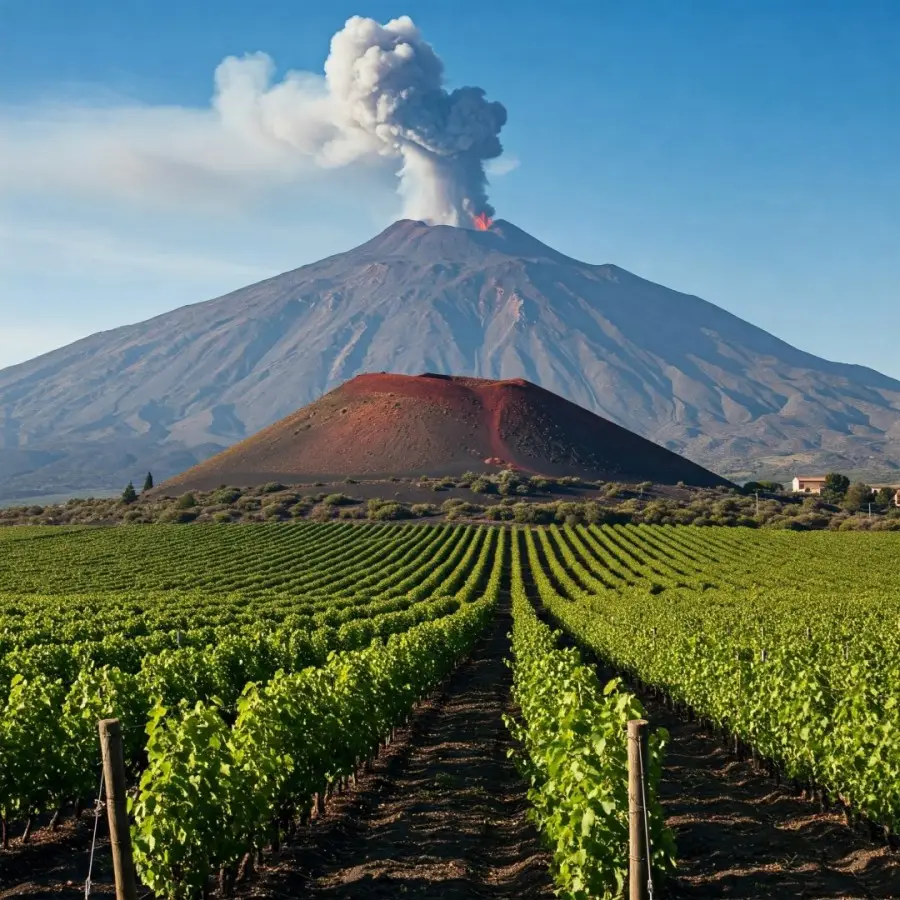
For many wine experts, Etna is currently the most exciting wine region in Europe. Sicily is the largest Mediterranean island, full of contrasts, and because of its position it has, throughout history, been steeped in different cultures and influences. It could be said that what has happened on Etna in terms of wine production over the last 20 years is a small miracle. When you consider what was going on in Sicily itself before that, the achievement is all the more remarkable.
Sicily had, in fact, been flooded with new vineyards of international – mostly French – varieties, which was important for Sicily’s breakthrough as a great wine island onto the world stage, yet at the same time it was a heavy burden, because wine critics viewed it as Europe’s answer to New World wines. Some, however, thought differently. The Benanti winery made the most important step forward in that direction, under the guidance of its then-oenological consultant Salvo Foti, who today is one of the most sought-after leading experts on Sicily’s indigenous varieties.

As early as the beginning of the 1990s, Foti argued that Sicily’s indigenous varieties – and especially those from Etna – were a genuine treasure, and that they would surely realise their potential and achieve worldwide fame and recognition. He was, of course, right. Today his masterpiece, Benanti Etna Bianco Pietramarina, is deservedly the most celebrated wine of Etna. It is made from the indigenous variety Carricante, grown at roughly 900 m above sea level, and can effortlessly age in bottle for more than 20 years; in its finest guise, tasted blind, it recalls a curious cross between a mature German dry Riesling and a Loire Chenin Blanc. A similar standing belongs to the Etna Rosso Serra della Contessa from the same winery, made from 100-year-old vines of the Nerello Mascalese variety.

True critical and media recognition of Etna as a region, however, came with the so-called newcomers to the mountain itself: Andrea Franchetti of the Passopisciaro winery and Marc de Grazia of the Tenuta delle Terre Nere winery. Their devotion to precise, almost Burgundian-elegant wines did not go unnoticed, and showed what could be produced on the volcano’s northern and eastern slopes. They were then followed by the great Sicilian houses such as Planeta, Cusumano, Tasca d’Almerita and Donnafugata. All of them adopted an almost Burgundian cru principle, defining the finest sites, which on Etna are known locally as contrade.
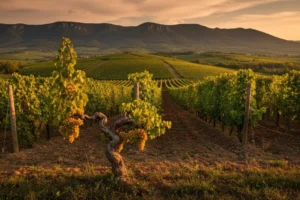
Today there is a vast catalogue of contrade, each with its own micro-terroir signature that is carried into the bottle. A hallmark of Etna’s vineyards is the old alberello planting system, which literally means “little bush”.
Alongside those already mentioned, we must also point to a large group of growers who hail from Etna or the surrounding villages: Alberto Graci, Michele and Mario Faro of the Pietradolce winery, the Girolamo Russo winery, the Maugeri family, and several others – among whom the important ones are the “I Vigneri” project of Salvo Foti himself and the Belgian Frank Cornelissen, a pioneer of the non-interventionist wine style on Etna.

What makes Etna’s wines so special? First, the volcanic soil, rich in minerals. Then the climate, which is surprisingly cool – for although this is the south and the Mediterranean, it sits at high altitude. There is also an extreme swing between day and night temperatures. So what are Etna’s wines like? Mineral, with a high underlying acidity, both whites and reds. They have very good ageing potential and, in style, can be regarded as cool-climate wines. Etna can even be considered a small wine continent of its own within Sicily, and within the rest of Italy.
Etna’s wines are mainly divided into three categories:
- Etna Bianco – produced mainly from the Carricante variety, and may contain smaller proportions of Catarratto and Minella
- Etna Rosso – from the Nerello Mascalese and Nerello Cappuccio varieties
- Etna Rosato – a rosé wine from the same varieties as Etna Rosso
An interesting fact is that on Etna itself one can find experimental plantings of Riesling, Pinot Noir and Chardonnay.
The most important wines
Benanti Etna Bianco Pietramarina, Maugeri Etna Bianco Contrada Volpare Fronte Bosco, Tenuta di Fessina Etna Bianco A’Puddara.
Benanti Etna Rosso Serra della Contessa, Girolamo Russo Etna Rosso San Lorenzo, Pietradolce Etna Rosso Archineri.
Girolamo Russo Etna Rosato, Maugeri Etna Rosato Contrada Volpare

We warmly encourage our readers to seek out the wines of Etna and to experience for themselves why wine critics and the media currently regard it as the most exciting wine region in Europe. Just as Etna’s last great eruption, in 1981, displayed the power of the volcano, so in the wines of Etna one senses that very same energy — the power of the volcano in every glass.